
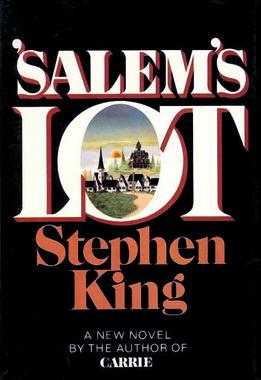
When I moved to Stephen King’s home state of Maine, I thought it would be fun (if a bit cliché) to finally read his books in earnest, and discover how I really feel about his work. For this installment, I made a crucifix out of some popsicle sticks, turned on all the lights, and dug up my copy of ‘Salem’s Lot.
During my day job as a copywriter for an outdoor retailer, I’ve learned a lot about the scientific effects of going outside – even a 10-minute walk has been proven to make humans happier, because deep in our lizard brains live the instincts of our ancient ancestors, who spent the majority of their lives out in the elements.
For his masterful second novel, Stephen King teaches a similar lesson about the long memory of human DNA – when we were out there hunting and foraging and trying our best not to die, we developed all kinds of involuntary fear responses. Those goosebumps that run up your arm when you walk into a dark basement? That’s not you being a scaredy cat – it’s a very real echo from the dark corners of human history.
On its surface, ‘Salem’s Lot should be something we can easily put out of our minds once we put it back on the shelf. It’s a vampire novel that doesn’t try at all to update the lore we’ve been exposed to a million times over. The bloodsucking creatures in the fictional bad-luck town of Jerusalem’s Lot, Maine, could’ve come right from Bram Stoker – they sleep in coffins, can seduce you with their voices, and can be harmed by daylight, crucifixes, and that good old fashioned wooden stake through the heart. It should be easy for us to think “cool story bro, but vampires aren’t real,” and sleep like the dead.
Yet this is one of the straight-up scariest things I’ve ever read, from Stephen King or any author. And I think it’s because King refuses to keep these cobwebbed, plasma-stained goings on at an arm’s length. He wants us, his Constant Readers, to identify with the rag-tag group of townies who slowly realize what’s going on in their sleepy burg, and then have to figure out how to fight it. He lays clear how their feelings are not foreign from ours. And in so doing asks an absolutely terrifying question – if our bodies are afraid of very real dangers from the past, what do we risk by ignoring them?

As two central characters – the optimistic college grad Susan Norton and nerdy tween Mark Petrie – plan to break in to the epicenter of the vampire infestation, the long-abandoned Marsten House mansion, King describes Norton’s involuntary reactions in a way that would sound familiar to anyone who has gotten lost in an unfamiliar place; or woke up to find their feet uncovered and promptly put them back under the sheets; or heard a bump in the attic and decided to wait until morning to investigate:
All the thought processes, the act of conversation itself, were overshadowed by a more fundamental voice that was screaming danger! danger! in words that were not words at all. Her heartbeat and respiration were up, yet her skin was cold with the capillary-dilating effect of adrenaline, which keeps the blood hiding deep in the body’s wells during moments of stress. Her kidneys were tight and heavy. Her eyes seemed preternaturally sharp, taking in every splinter and paint flake on the side of the house. And all of this had been triggered by no external stimuli at all: no men with guns, no large and snarling dogs, no smell of fire. A deeper watchman than her five senses had been wakened after a long season of sleep. And there was no ignoring it.
As if these shared biological insights weren’t enough to get us freaking out about vampires right alongside Susan Norton, King makes extra sure we’re primed for it. The Marsten House break-in doesn’t happen until over 400 pages have flown by. King takes his time setting the stage, letting the dread slowly creep into every nook and cranny of his imaginary town, giving us only brief glimpses of the monsters responsible for it all.
Our story begins with the arrival of Ben Mears, a novelist who returns to his hometown of Jerusalem’s Lot with a vague plan to write about the Marsten House, where he had a terrifying experience as a child. As Ben gets his bearings, befriending Susan as well as a lovingly rendered atheistic English teacher named Matt Burke, someone else arrives in town. And he moves into the house of Ben’s nightmares.
Richard Straker is obviously not a Mainer returning to the nest. Notably tall, bald as an egg, driving an ancient Packard, and speaking in an antiquated way (“Attend over at this meat case, please”), he seemingly pops up out of nowhere to open an antique shop called Barlow & Straker, despite there being zero tourist trade in this town of 1,319 “where little of any note ever took place.” His partner Barlow had not arrived yet. And those who would eventually meet him would be, shall we say, forever changed.
As the body count rises, King makes the point, over and over again, that we ignore our gut feelings at our own peril. The way he describes Mark Petrie’s father Henry – an insurance administrator with CPA dreams – it’s obvious he’s not gonna last long:
He was a straight arrow, confident in himself and in the natural laws of physics, mathematics, economics, and (to a slightly lesser degree) sociology. […] His calmness increased, it seemed, in direct ratio to the story’s grotesqueries and to his wife June’s growing agitation. When they had finished it was almost five minutes of seven. Henry Petrie spoke his verdict in four calm, considered syllables. “Impossible.”
By our standards of human behavior, Henry Petrie did everything right in the face of a stressful situation. He kept calm. He thought logically. He used everything he had learned about what was real and what was fantastical to influence his decisions. And every second of responsible deducing brought him that much closer to a brutal end. This is why ‘Salem’s Lot is one of the scariest books of all time. We can pretend we know how everything works and that we’re too mature to be afraid of that dark, dusty basement. Maybe that’s true.
Maybe.
“THE “CATCHING UP WITH KING” RANKINGS
5. ‘Salem’s Lot
14. The Dark Tower I: The Gunslinger


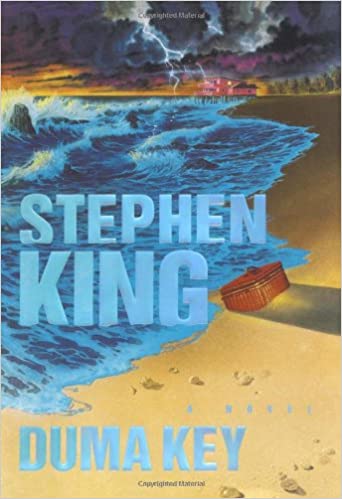 On the rare occasions when King sets his stories outside of Maine, it’s usually for a good reason. Duma Key is no exception. The author and his wife Tabitha began spending their winters in the Sunshine State in the late-’90s, after a falling icicle almost killed their dog. “We never really came to terms with the fact that we were rich” until that moment, King told USA Today. They got a place in Sarasota, a short drive over the bridge from islands like Siesta Key. Duma Key is a fictional place, but it is set off the coast of Sarasota. So when King writes about visiting tourists blasting Toby Keith and ruining his day, it’s safe to say that we’re reading the very real complaints of an honorary Floridian.
 Wireman is only one of a handful of colorful-yet-haunted characters that populate this story, including the octogenarian art patron and wealthy heiress Elizabeth Eastlake, whose tragic family history is tied up with the ancient evil that resides in Duma Key’s ominous psychotropic jungle. Edgar’s wife and daughters play critical, life-saving roles, a vision of how post-divorce bonds can transcend bitterness. A boozy Tampa art critic steals a few scenes, and Edgar’s pseudo-assistant Jack is a lovable and supportive kid with a knack for keeping his boss sane. It’s a classic King strategy – make you care about people as they become closer and closer friends, and then seal that bond with a healthy dose of shared trauma.
 Like 99% of authors, Stephen King is at his best when he’s writing about what he knows. And like 99% of wealthy white male authors, Stephen King thinks he knows way more than he actually does.
 about is what effect this publishing decision could have on writers like himself. It’s an ignorant, privileged perspective. It’s really hard to read.
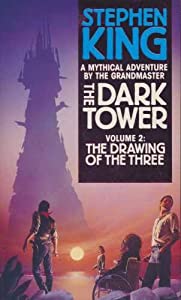 The first is Eddie Dean, a character King could write well in his sleep – a heroin addict from a dysfunctional family. From the moment Roland steps through the door and into Eddie’s mind, The Drawing of the Three becomes an oddly gripping, metaphysical buddy action movie, complete with a climactic shootout at a drug lord’s lair. This is King writing what he knows and boiling it down into Grade A pulp fantasy.
 description of a gunslinger to a tee. If only King could’ve stopped there.
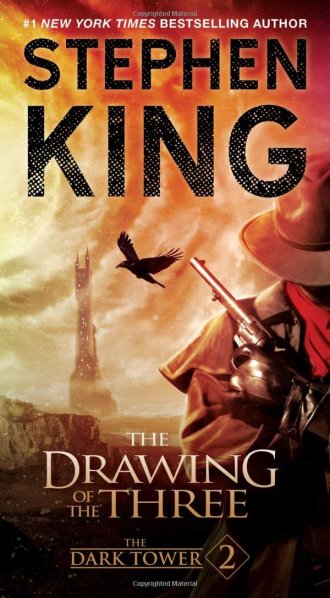 Imagine being truly engrossed by a book that depicts a fantastical world colliding unexpectedly with our own. And then imagine having to contend with this dialogue, and these descriptions, for hundreds of pages. It’s like watching Stephen King tweet passionately about why Elizabeth Warren should be president, and then having to deal with his defense of Woody Allen out of nowhere. It’s literary whiplash.
 In 2013, shooting wrapped on the Richard Linklater film Boyhood, a project that took 12 years to make, because it was filming its child star, Ellar Coltrane, in real time. As we watched the main character grow from a 6-year-old to a college freshman, we were watching Coltrane grow, too. It turned out to be little more than a gimmick – Boyhood is a fairly forgettable domestic drama. If only it had a fraction of the narrative thrust of another 2013 experiment in fictional growth, Stephen King’s absolutely gripping literary sequel Doctor Sleep.
 Doctor Sleep is the story of Danny the student becoming Dan the teacher. After hitting rock bottom, he somehow finds his way back above the waterline, in a small New Hampshire town. His first boss becomes his long-time AA sponsor. (This book is loaded with AA references, but King sprinkles enough healthy skepticism around to avoid getting preachy.) His job as a custodian at the local hospice center helps him discover his calling – Dan uses his shining to help the dying cross over, providing them with the kind of definitive serenity that no priest could ever gin up. And, most critically, Dan finds himself one town over from a 12-year-old girl named Abra, who shines more powerfully than perhaps anyone in history.
 Dan feels Abra shining pretty much from the moment he moves to New Hampshire. She “writes” him notes on his apartment wall, and they slowly get to know each other, exclusively via the shining. Dan thinks of her as family. And when she’s endangered, he and the few others who know of her abilities come up with a few elaborate ruses to destroy the Knot, without using her as bait. This sequence of the book is just impossible to put down, a gripping, fantastical showdown between the living and the dying, the givers and the takers, the listeners and the din. And through it all, we’re seeing that 6-year-old kid – who watched his father lose his mind, who was so close to the edge of destruction for most of his life – face his own demons, along with Abra’s.
 Stephen King is not synonymous with fantasy quest narratives – the kind of stories that rely on meticulous world-building, magical elements, and traditional constructions of good and evil. But it’s not for a lack of trying. Although its scope included every random thought in the author’s brain, the spine of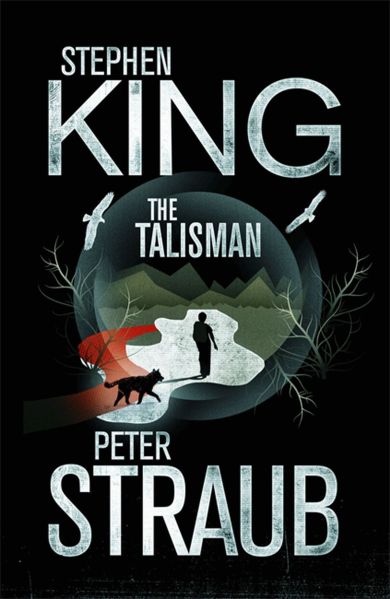
 The closer Jack gets to his goal, the more rushed and sloppy the narrative becomes. After picking up his best friend Richard (Morgan’s traumatized son) on his way west, Jack flips with him, and then steals Sloat’s battery-powered train to ride through the “Blasted Lands.” In an unforgivable bout of laziness, the authors fill the back of Sloat’s train with assault weapons, minimizing the threat while expecting us to believe that two 12-year-olds would know how to use them. (Picture Frodo and Sam finding a pair of bazookas on the road to Mordor.)
 Perhaps more than any other artist, writers want us to know that they’re suffering ever so much. “Writing a book is a horrible, exhausting struggle,” whined George Orwell. “I think all writing is a disease,” bemoaned William Carlos Williams. “All you do is sit at the typewriter and bleed,” bitched Ernest Hemingway. Has anybody in human history ever been more full of shit? These guys got to work from home, keep their own hours, explore their every creative whim, and make good money in the process. Karma dictates that they be punched in the stomach by a factory worker.
 Still, to this reader – who realized a long time ago that his fiction was irreparably bad – the autobiographical bookends are the main reason to read On Writing. King begins the book with charming snapshots of his childhood, hopping around the country being raised by his mother. As he gets older, he starts writing in his little attic room, amassing rejection letters like Tennessee Williams. And as we get whisked through the rest of the 20th century, from his big break with Carrie to the summer day in 1999 when he got hit by a van while taking his daily walk, there’s one constant – his wife and fellow author, Tabitha.
 Drugs get too much credit for great works of art. Sgt. Pepper’s is widely considered to be The Beatles’ “LSD album,” despite the fact they quit touring right before they recorded it, allowing them to focus 100% on studio innovations. Salvador Dali’s surrealist visions led people to assume that drugs must be the cause, but all signs point to him being clean: “I don’t do drugs,” he claimed. “I am drugs.” It’s not as romantic, or inclusive, of a narrative, but imaginative art doesn’t come from substances. It comes from people who are really, really imaginative.
 So, before we know anything else about Sheldon, we know he’s an addict in a bind. And, as King was sure to know first hand, this ebb and flow of pain and bliss would make it excruciatingly difficult for his character to think critically. It would take forever for him to fully understand how he had leapt from the frying pan into the hellfire. Every time the drugs start to wear off, it’s a race between Paul’s wits and his nerve endings. He’s an addled bomb squad captain, running out of time.
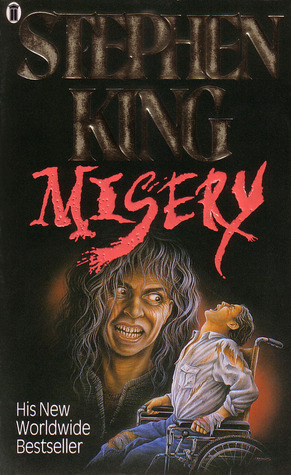 The more Paul gets his wits together, the more intense Misery becomes. Despite his shattered legs and debilitating addiction, he figures out how to pick the lock on his bedroom door while Annie is running errands. We’re right there with him as he wheels through the house, weighing the odds of escape. The more we rack our brains, the more we realize that the only way out is to discover if the pen is indeed mightier than the sword. The book then reaches a new level of poignancy as King lets his meta flag fly. Paul decides to bring his beloved main character, Misery Chastain, back to life in a brand new novel. Because as long as he’s writing, Annie can’t kill him. She needs to find out what happens. She, too, is addicted. Here she is, talking about how much she loved cliffhanger-heavy film serials when she was a kid:
 Perhaps all he had hated was the fact that her face on the dust jackets had overshadowed his in his author photographs, not allowing the critics to see that they were dealing with a young Mailer or Cheever here – they were dealing with a heavyweight here.”
 In the introduction to the extended edition of his 1978 novel The Stand, Stephen King had this to say about his writing process:
 survivors, left scattered across our tired, polluted country. Like Stu Redman, a standard-issue soft-spoken Eastwood hero from East Texas. And Fran Goldsmith, a Maine college student prone to fits of giggling who is impregnated by an indifferent boyfriend right before the plague hits. And Larry Underwood, a journeyman musician and all-around selfish idiot who’s just landed his first hit single.
 I’m not here to say that Stephen King is racist. But these moments in this book absolutely are. According to 2017 U.S. Census data, 94.8% of Mainers identify as white. It’s probably safe to say that growing up in 1950s Bangor, King wasn’t exposed to much diversity. Non-white people were people outside of normal life. Not inferior, but other. So he ends up using the heinous backhanded compliment that is the
  makes humanity unique, and uniquely self-destructive. The story arc of the bullied Harold Lauder is a fantastic exploration of how toxic masculinity can turn boys into monsters.
 What scares Stephen King? Based on what we’ve read so far in this series, we can make some guesses (e.g. cycles of abuse, bathrooms). But after reading his 1998 novel Bag of Bones, and looking into how his career was doing at that time, I think I may have uncovered the big kahuna: Tom Clancy.
 King is rarely better than when he’s writing about grief, and this is no exception. Like when Noonan finds an old W. Somerset Maugham paperback under the bed, with a playing card used as a bookmark: “It occurred to me that Jo was never going to turn the page and hear Strickland call the pathetic Stroeve a funny little man,” King writes. “I understood it wasn’t a mistake that would be rectified, or a dream from which I would awaken. Johanna was dead.”
 Ickiness aside, King is out of control here. Like the ghosts duking it out in the lake house, King’s tangled plot lines strangle any potential points that Bag of Bones could have made. What promised to be a story about harrowing grief and what constitutes fulfillment for a once-idealistic generation, becomes a literal bloody mess. King has to resort to a gruesome deus ex machina to prevent the Mattie/Michael relationship from going “too far.” And the Sara Tidwell secret is truly horrifying, and fairly offensive in how quickly it’s tossed in – like an extra tablespoon of lemon juice in an already sour cocktail.
 sweensryche.com