Catching Up With King: The Gunslinger

When I moved to Stephen King’s home state of Maine this summer, I thought it would be fun (if a bit cliché) to finally read his books in earnest, and discover how I really feel about his work. For this installment, I decided to “cowboy up” – which is a thing you can do, apparently – and take on Book One of the Dark Tower series – The Gunslinger.

“Everything in the universe denies nothing; to suggest an ending is the one absurdity.”
–The Man in Black

The_Gunslinger2

If one wanted to take a swipe at Stephen King, the length of his novels seems to be the obvious place to start. None of the books I’ve tackled here so far have been especially bloated, but his loyal readers are certainly no stranger to shelf-punishing hardcovers. Of course, this invites accusations of King having a problem with endings, or a puffed up idea of his own literary significance, or a celebrity that handcuffs his editors. But I’m pretty sure this line of criticism is a lazy one, because I just read The Gunslinger – the first entry in King’s seven-part-and-counting Dark Tower series, and the opposite of a 1,000 page door-stopper – and it left me wanting so much more.

When this book came out in 1982, it must have thrown King junkies for a bit of a loop. Written in simple, muscular language, The Gunslinger is a starkly different genre exercise then the supernatural/domestic clash fiction that made the author famous. King borrows from an eclectic array of fantasy tropes to build his world – including spaghetti westerns, 1950s post-apocalyptic sci-fi, Arthurian legend and the multiverse theory – boiling them down to the most basic of quest stories, where the obviously good guy (The Gunslinger) follows the obviously bad guy (The Man in Black), across a desert hellscape, getting closer and closer until he finally catches up with him. Plus, there’s a kid. It’s not a bad idea on paper – King writes the weirdo Sergio Leone script of his dreams, adding his own shadows to the good and the bad, but focusing most of all on the ugly, resulting in a Cormac McCarthy-meets-J.R.R. Tolkien mindfuck of a masterpiece. That’s what I wish this book was.

What it actually is, is way too slight. So few characters having even fewer conversations, with the emptiness of the landscape getting more play than anything else. I get that when your main character is the strong, silent, Eastwood type, your story isn’t going to be dialogue driven. But there isn’t much plot here to speak of either – Good Guy follows Bad Guy from Point A (desert) to Point B (mountains). Good Guy picks up Mysterious Boy. Good Guy bonds with Mysterious Boy. Good Guy makes Difficult Choice in regards to Mysterious Boy while following Bad Guy from Point B (mountains) to Point C (fire pit on other side of mountains). The End.

Now, I’m fully aware that context is playing a role here. I read The Gunslinger immediately after finishing The Shining, a gluttonous feast of character development that puts us inside the head of a gifted child, who becomes a portal into the heads of everybody else – while also carefully laying out the dark and complicated pasts of both a haunted hotel and the family trapped inside of it. I also read The Gunslinger with the knowledge that it’s the first book in a beloved fantasy saga – something I usually have a weakness for. So you could say I went in expecting The Fellowship of the Ring, and I got a few chapters of a shorter, picture-book version of The Hobbit.

While there are elements of the story that intrigue me and will compel me to read on – most especially the beautifully regaled flashbacks that make up The Gunslinger’s pre-apocalyptic, pseudo-Arthurian origin story – King’s world just isn’t in the same galaxy as a Middle Earth. Or even a Westeros, for all its obsessive-compulsive flaws. Maybe in future installments, King will abandon the cowboy novelist pose and just write his ass off while losing himself down all kinds of bizarre rabbit holes, fleshing out the scraps of promising meat from this skeletal beginning. Maybe there will be hundreds of pages of stuff that makes the story much longer than it probably needs to be. I can only hope.

Catching Up With King #1: Pet Sematary
Catching Up With King #2: The Shining

Catching Up With King: The Shining

When I moved to Stephen King’s home state of Maine last month, I thought it would be fun – if a bit cliché – to finally read his books in earnest, and discover how I really feel about his work. For this installment, I let the Overlook Hotel tell me what to do – unsurprisingly, it chose The Shining.

“Has it ever occurred to you what would happen to my future, if I were to fail to live up to my responsibilities? Has it ever occurred to you? Has it?”
–Jack Torrance

200px-ShiningnovelEven though I’m merely two volumes into this little project of mine, I feel like I have a pretty solid grasp on what makes Stephen King’s best work tick. He doesn’t restrict his creepy crawlies to the supernatural realm, and that’s why his stories have struck such a resounding chord with a wide swath of humanity. Just like Pet Sematary, which twisted the intensity of parental love into something thoroughly unwholesome, The Shining takes a universally understood emotion and holds us hostage with it.
The feeling in question here involves the nature of free will, and the frightening implications of its absence. The Shining is as much a classic ghost story as a study of family dynamics, pitting the Torrances – father Jack, mother Wendy, and son Danny – in a battle against not only the hostile spirits of a haunted hotel, but also the rather shoddy track record of its own DNA. After losing his teaching job at a Connecticut prep school because of a violent incident with a student – a job that was already on shaky ground thanks to his alcoholism – Jack takes a job as the winter caretaker of the Overlook, a ritzy, destination hotel high up in the Rocky Mountains. The Torrances will be the only residents in the huge old structure for the entire season, during most of which they will be completely snowed in. It’s a setup that hasn’t always gone well – the previous caretaker murdered his family, for instance – but whatever. Jack sees it as the perfect way to get back on track, with his writing career and his family (in that order).

King’s metaphors can be a little on the nose, like the outdated furnace that can’t handle as much pressure as it used to, but the snowed-in hotel works sturdily as a symbol of what stands in Danny’s way. Despite all of Jack’s dreams and aspirations, he ended up a spitting image of his asshole father. Wendy isn’t on speaking terms with her cold, judgmental mother, and one of Jack’s go-to insults is to say she’s acting just like her. Like the Overlook, Danny’s home life is stacking the cards against him, and the obstacles are just getting scarier and more intimidating. Which brings us to the core question of the novel will all of us, whether we like it or not, become exactly like our parents?

The Shining would be one hell of a suffocating read if its answer was “Yes.” Thankfully, King’s opinion on the matter is more hopeful, coming in the form of the titular psychic gift that Danny possesses – the ability to read people’s thoughts, and to go deep enough within one’s self to see visions of the future (courtesy of a figure Danny calls “Tony”). When Danny meets Dick Hallorann, the Outlook chef, he has his first encounter with somebody else who “shines,” and it’s no coincidence that he’s by far the friendliest and most heroic character we meet, other than Danny himself. People who are able to step outside of themselves are more likely to have a greater understanding of others, King posits. And this understanding gives them the perspective necessary to make a deeper connection with their true self – their “Tony,” if you will – no matter what horrors might stand in the way.

The book ends with a conversation between Danny and Dick about how to overcome, and its poignancy goes down all the easier after such a long, dark, claustrophobic struggle. For me, this is what makes King’s novel a more meaningful achievement than Stanley Kubrick’s film (which still trumps the book as sheer entertainment). Where the latter has no regard for the Hallorann character and is satisfied with a purely physical escape for Danny, the former ends with the two telepathic heroes sitting by a Maine lake in the summertime, placing itself firmly on the side of healing, and freedom, and hope.

Catching Up With King #1: Pet Sematary

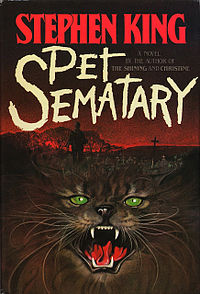
Catching Up With King: Pet Sematary

I read very little Stephen King growing up, partly because Douglas Adams was more my kind of thing, and partly because my brother read King and we took care not to infringe on each other’s pop culture obsessions (e.g. I loved Metallica, he loved Megadeth, and never the twain shall meet). But when I moved to King’s home state of Maine in June, I had the frightfully clichéd idea that now was the time for me to catch up on all the stories I’d heard so much about and/or seen in movie form. The first one I picked up might be the Maine-iest of all – 1983’s Pet Sematary.

“…Gage was still in his crib, sleeping in typical Gage fashion, spread-eagled on his back, a bottle within easy reach. Louis paused there looking in at his son, his heart abruptly filling with a love for the boy so strong that it seemed almost dangerous.”
–Stephen King, Pet Sematary

Pet Sematary

As somebody who doesn’t have kids, I’ve been told many times that everything changes once they enter your life, and not just your sleep patterns; your love for this small and helpless thing you helped create becomes so intense, it does something to the fiber of your being. Call me naive or unfeeling, but that scares the shit out of me. Which goes a long way towards explaining why Pet Sematary really got me good.

The plot is standard horror fare – Doctor Louis Creed moves his wife Rachel and two children (Ellie and Gage) from Chicago to a big old farmhouse in Ludlow, Maine, where he was recruited to run a college infirmary. He immediately befriends Jud Crandall, the 83-year-old man who lives across the highway (and regular trucker route), when Jud plucks a bee stinger out of Gage with unexpected dexterity. Jud proves to be a well of knowledge about the woods abutting the Creed property, eventually leading the whole family on a hike up to an old, seemingly harmless pet cemetery. Yet the trip really bothers both Rachel and Ellie, the specter of death not something they’re comfortable thinking about (especially Rachel, whose gruesome, bone-chilling memories of her late sister Zelda make for some of the book’s most visceral moments). Soon after, with the wife and kids away visiting the in-laws, the family cat Winston Churchill is run over by a passing semi, and Louis’ heart breaks at the thought of having to tell his daughter. Jud, who feels he owes Louis for saving his wife Norma when she had a heart attack, tells him there’s a special place they can bury it …

You probably have a good idea where the story goes from there. Suffice it to say that it’s not the last we see of the Creed family cat, and after a gut-wrenchingly tragic human death, things get a whole lot worse. But – and this is something I never really expected to think about King’s writing – the storytelling isn’t what makes Pet Sematary truly horrifying. It’s that the thing driving Louis to drag corpse after corpse into the woods is the same thing that parents always use as a selling point – a love so strong, it changes everything. In the blink of an eye, those unfathomably intense feelings for your fragile creation can transform into crippling fear, or worse – the kind of grief that forever warps the mind.

So while King’s writing is as satisfyingly pulpy as ever, gleefully regaling the sluggish movements of a reanimated house cat in sickening detail – right down to its un-Febreze-able grave-stench – his creation claws at something deeper within our hearts. Yes, this is the kind of scary story you could tell around a campfire. But it’s also one that confronts people who say they’d do anything for their child, and asks them, “Anything?”

On our next trip through King country, we’ll talk about The Shining, a King book that has the rare task of living up to its movie adaptation. I suspect I’ll agree with Stanley Kubrick’s decision to trim the hedge animals (from the script).